Levin Willey (1812-1870) of York, PA wrote a letter to his brother on 28 December 1854. There are many details in the letter and, as tempting as it was, I did not try to resolve all of the questions I had. The family is well-documented in databases and, no doubt, genealogists will find much to learn from it.
Three things in the letter enabled me to confirm the letter’s author and the date of the letter. Levin told his brother, “The Rail Roads which I am engaged on have consolidated, that is united and now form one company from Balto to Sunbury, a distance of 140 miles. This in addition to the [word] boiler and the Hanover Branch Road will give me my hands full, but I have made up my mind that a man can do almost anything if he determinedly makes up his mind that he will do it, hence I have no fear but what I can manage the repairs of the whole line to the satisfaction to myself and the company.” An item in Baltimore Sun published two years before Levin wrote this letter confirms this information:I first thought the author’s given name was Alvin and did find three newspaper articles about a railroad man named Alvin Willey in York, but there were dozens more about Albert Willey (1845-1888). Albert turned out to be Levin Willey’s son, and “Alvin” turned out to be an apparent combination of Albert and Levin. Albert was a distinguished railroad man himself, but he sold out and moved his family to Philadelphia where he died in 1888 leaving a widow and three children. At the time of his death he was the switch tender at the tower at [N] 52nd Street.
Albert was executor of the estates of both of his parents. In Levin’s case, one of the documents he filed after Levin’s death in 1870 was an 1868 claim to be compensated for a “board tent which was destroyed on the Shrewsbury Camp Meeting Ground in Shrewsbury Township, York County, PA., in the Fall of 1862 by the Union Soldiers under command of Col. Kane, while they were encamped on said Ground. –Said tent being worth 65.00.” It was by comparing the signature on the letter with the signature on the claim that I confirmed the name of the letter’s author. You can read more about the campground and the incident here.
Finally, Levin informed his brother that “Nat Johnson has got his second wife. Nat owns the mill which belonged to my father and is making money.” That mill is now known as Abbott’s Mill. Levin’s father was Nathan Willey (1775-1812). According to a Fall 1984 article in The Archeolog, the mill to which he refers is now known as Abbott’s Mill Nature Center in Millford, DE.
Here is a transcript of the text. Let me know if you spot a typo.
York, Dec 28th 1854 Dear Brother I received your letter this day and happy to hear of your continued good health and prospects and hope a long continuance of the same blessings. You wish to know where your Father died and where buried. I made the inquiry when in Del. and I think I was told he died at his son Jacob’s. He was buried by the side of Mother. Your inquiry in regard to Nancy and Rachel, I can only answer in part. They are both married in living in the Western Country somewhere. Nancy married Shadrack Postles. Rachel married a Macklin, and I think a son of old Nutter Macklin. I have not either of them for the last ten years. Sarah Willey is married to a man by the name of Samuel Downey, a boiler maker, and resides in Wilmington, Del. You may perhaps remember Downey. He worked and lived in Newcastle when you was there. Downey is sober industrious man and makes a good living. They have one child living, an interesting little girl of seven or eight years. I was in Wilmington last summer and brought Sarah and her daughter home with me. They spent two weeks with us and was much pleased with the place and people. Elizabeth Jane is married to a young man in Wilmington and has one child. Mary Ann is a Tailoress and lives in Wilmington. Maranda the youngest of Alexanders children lives with Benjamin Point and has for the last ten years after the marriage of Rachel Ann their daughter they adopted Maranda and [word] her as their daughter up this time. Old Charley Palmer is still the same old Cock that he was when you saw him last, neither better nor older to all appearances. Mrs. Palmer is still living and looks as well as she did many years ago. John Eckes is farming on the farm belonging to Bill Booth out of New Castle. John is doing well, has a home full of boys and is still very religious. I cannot think of any others just at this time in NewCastle that you could take any particular interest in. I received a letter from Wm N. Slayton a short time ago. The people are generally well in Sussex. I have not heard from Elizabeth since I wrote you and cannot say how they are getting along. but I fear bad enough. Manlore Johnson and old Beck are [word], which is bad enough. Old Duck is farming in Cedar Neck and doing very well. I stayed one night with him while in Del. He is the same old Duck, loves to play old sledge and drink whiskey but is the same good hearted clever fellow as of twenty years ago. Old Jim Taterman married Jinny five or six years ago. He is now one of the fatest old rascals in the county. John A. Collins has a house full of children but no wife, I mean legally. I was to see old Uncle Jimmy and Aunt Lizzy Johnson. The old man is getting very feeble but the old lady is as fat as ever. Mary Ding, or Ben as you used to call her is at home with the old folks and looks better and handsomer than she did twenty years back. Analiza married Nathan Fleming and has been dead seven or eight years. Sally married a Stuart. Sally Ann Stuart, Phillip Stuart’s wife is married to old Bill [word]. Sam Wilkinson who no doubt you remember was arrested the other day for robbing the U.S. mail. He will now wind up where he ought to have been twenty years ago. Old John Hays has got his second wife and several children. With the exception of his grey head he looks as young as when you saw him last. Tom Hays is living and about the same. His daughter Eliza Ann is dead. Old Aunt Katy Hays is living or was in August, but blind and very feeble. The farmers have improved their land very much in Sussex and many important changes have take place since you was there. Nat Johnson has got his second wife. Nat owns the mill which belonged to my father and is making money. It is said Black Elic, John, Sam, and Dave are all living. Crow Black I suppose you know married Sally Macklin. The others are all single. The Rail Roads which I am engaged on have consolidated, that is united and now form one company from Baltimore to Sunbury, a distance of 140 miles. This in addition to the [word] boiler and Hanover Branch Road will give me my hands full. But I have made up my mind that a man can do almost anything if he determinedly makes up his mind that he will do it, hence, I have no fear but that I can manage the repairs to the whole line to the satisfaction to myself and the company. I have been making my arrangements to come to come to see you in January if possible and I know of nothing at this time that will prevent it. I shall bring with me the superintendent of transportation and we intend to make an exploring expedition among other Rail Roads there by attend to business and pleasure at the same time. If everything proves favorable we shall leave about 10th January. We are all well. Had a happy Christmas and hope you had the same. Money matters are very [word] here at this time but it is expected that after the10th January it will be easier. Write immediately on the reception of this as I would like hear from you beforehand. Tell me if you have plenty of game in your country and what kind. I would very much like to kill some prairie chickens. Your Affectionate Brother, Levin Willey If there are any words in this letter you can’t make out you will excuse them and all mistakes for I had just one hour to write it in.
Priscilla D. Austin (1840-1904) wrote the above letter to her brother, Joseph Bradley Austin (1850-1901) on 27 December 1868. She was in Middletown, PA with her husband, David Larish (1830-1892), a Methodist Episcopal [MEC] clergy, and their only child, Elmer Harry Larish (1868-1899). [A lightly edited transcript of the letter is below.]
I don’t know which Middletown Priscilla was visiting when she wrote and context doesn’t give much help. Four Middletowns in PA pop up when a broad search is done, the most prominent one being on the Sequahanna River. Middletown, CT isn’t far much farther away and it is the location of Wesleyan University which was started by the MEC in 1831. Finally, there was a Middletown in Luzerne County, near Hazleton, that no longer exists.
Joseph Bradley “J.B.” Austin (1850-1910), who was living in family home in Muhlenburg, Union Township, PA in 1868, would marry Sarah C. Dymond (1846-1927) in 1872. Joseph held “several offices” in Union Township and was the tax collector when he died. They had four children. [Townships are “the lowest level of municipal incorporation of government.]
Priscilla mentions two preachers associated with the meeting at Bear Creek Church. Rev. Miner Swallow (1815-1898) married Eliza Mary Dobson (1821-1893) in 1840 and they had no children. At the time of the Bear Creek meeting Priscilla described, Swallow was on the Wyoming Annual Conference‘s “supernumerary list.” Rev. Dr. Rueben Nelson (1818-1879) married Jane Scott Eddy (1819-1899) in 1842 and they had three children. Nelson was a founder and the first president of Wyoming Seminary founded in 1844 in Kingston, PA. At the time of his death he was “senior book agent in charge of the Methodist Book Concern in New York City. At the time of the Bear Creek meeting describe by Priscilla, Nelson was “principle elder of the Wyoming District.” Both of these preachers are buried in Forty Fort Cemetery in Forty Fort, PA.
Monema A. Austin (1845-1916), sister to Priscilla and J.B., married David Doty (1840-1917), a farmer and a descendant of David Doty who was among the passengers aboard the Mayflower. An obituary observed that Monema, “during her entire life, she had never ridden on a train or in an automobile, or even as much as went to see her step-children.” She was survived by four step-children.
Finally, Margaret “Maggie” Austin, the third sister, was born in about 1836 and died, according to online genealogists, in 1877. I found Luzerne County newspaper articles that said a Margaret Austin married David Ross, Jr. in June 1876, and a Margaret Austin married Reuben D. Arnold in July 1876. I could find nothing more.
The parents of these children were Peter Austin (1806-1872) and Casandra Santee (1810-). The online genealogy of this family is extremely inaccurate in some cases.
Here is a lightly edited transcription of Priscilla’s letter:
Middletown, December 27th, 1868
Dear Brother,
You’re very kind and welcome letter came to hand some time since. Its contents were perused with much pleasure. There is not a person in the world that loves to hear from absent friends more than I. It is my joy beyond measure for me when I can associate with kind friends and converse with them verbally face to face. And when deprived of that privilege, it is a great pleasure for me to receive letters from them. I often think of home and the loved ones there. I fancy I can see the group seated around the fire and hear them talking and laughing as they used to do in by gone days when I had the pleasure of sitting with them. I think I would love to be there and join with you for a short season at least, but I am deprived of that privilege at present, and am therefore content with my lot. And if we should never meet again on earth it is joy for me to know that we may meet in heaven above where we will never part again.___________The reason I did not answer your letter before is this: I have not been at home since mother went away until yesterday. I was at Bear Creek and I did not get a chance to write. I enjoyed my visit there very well. The people were very kind to me, but Harry was sick nearly all the time I was there, which was not very pleasant. Last Sunday he was very sick all day. I began to think that I would not get home with him very soon but on Monday he was better and has been getting better ever since. He is quite well now.
Well, I suppose you would like to know how the meeting is going at Bear Creek. Rev. Miner Swallow was there in Dr. Nelson’s place. They had a meeting on Saturday night and on Sunday and Sunday night. Then it was so stormy during the week following that they could not have a meeting much of the time. There was no one at the alter of prayer until one week ago. Last Thursday night there were two who came forward since that time. There have been two converted and there are five still seeking the pearl of great price. I hope that there will be a great revival there, for Bear Creek is a very wicked place. Pray for us that we may have good success.
Tell Monema I received her letter last week and will answer it when the meeting closes. Tell her to write again for she owes me a letter yet. I was glad to hear that mother and Mira had a safe journey home and also that they were pleased with their visit for I was tempted to believe that they were both homesick while they were here and did not enjoy their visit, but if they did I am glad. I hoped to see more of you out here during the winter but I suppose mother was so discouraged before she got here because the road is so long from Wilkes Barre over here that I need not expect any more of you to visit me while I stay here. _______________Tell mother that Harry did not forget how to drum while he was at Bear Creek. He can drum better now than he could when she was here. He can sit alone now.
I want you to write as soon as you get this and let me know how that big meeting is going on that mother said Maggie talked so much about. I will not dare go to McKendree Church anymore if they are so nice there. I am afraid they will be proud and you know I do not like proud people.
Joseph, you must not let Mr. Nagle sit by the side of Sis. That will never do. It made you feel bad, did it not? Tell Maggie she must get by the side of Louis Wheeler when she goes to church. Do Lizzie G. and Wesley W. sit together in church?
Well, I guess you will think that this is a long letter and nothing in it, and you will think right if you do. If you get tired of reading it just put it in the fire and it will be out of your way. Give my love to father, mother, Maggie, Monema and all my friends. Tell them I would like to see them all once more but do not know when that will be. Larish sends his love to you all and says he wants you all to come and see us. Write soon and tell me all the news. Yours truly, Priscilla
Reverend William D. Finney (1788-1873) was a native of New London, PA, the son of Walter Finney (1747-1820) and Mary O’Hara (1753-1823). Finney married Susan LNU (1791-1817) who died a few months after the death of their son, Walter Scott Finney (1816-1817). He then married Margaret Miller (1790-1865) and they had six children:
Susan Finney (1822-1894)
John M. Finney, MD (1823-1896) was a beloved doctor in Churchville, MD for 50 years
Rev. Ebenezer Dickey Finney (1825-1904), a graduate of Princeton Theological Seminary who eventually settled as the first pastor of the First Presbyterian Church in Belair, MD where he was pastor from 1872-1895, and father to John Miller Turpin Finney, Sr., MD (1863-1942)
William D. Finney, Jr. (1829-1863) who died near Drytown, CA where he was a partner in the Maryland Quartz Mining Company
Charles M. Finney (1829-1897)
George Junkin Finney (1830-1906) who was a Harford County politician and judge who married Louisa Lyons Webster (1838-1927).
Rev. Finney was the pastor of the Churchville Presbyterian Church in Harford County, MD from November 1813 until his death, though his activities had been curtailed by age at the end. The nomination of the church for the National Register of Historic Places (HA-441) (NRHP) describes Finney’s arrival at Churchville this way:
The Churchville Presbyterian Church’s congregation, the oldest in Harford County, dates back to 1738, when it was chartered as the Deer Creek Presbyterian Congregation and was supplied by the Donegal Presbytery. Those early worshipers met, according to church records, in a log structure on Graveyard Branch, about two miles northeast of the present building. The congregation relocated to its now-permanent site in 1759 and built themselves a simple brick meeting house. But various issues began to divide the congregation into splinter groups of ever-decreasing importance; this unfortunate situation was worsened by the absence of any minister for 25 years. This decline was reversed, however, when the Rev. William T. Finney (sic) (1789-1873; B.A. Princeton, 1809) came to the parish. Finney was a native of New London in Chester County, Pennsylvania, where two of the Deer Creek’s elders heard him preach in October, 1812. The Marylanders were so impressed that they asked the young man to come to Harford and he agreed, being installed here on November 17, 1813. Finney revived the dying parish and caused the main block of the present church to be built.
There is a lot of information about Rev. Finney and his family and their influence on the development of Harford County. I’m a little surprised I didn’t discover a book about them. Three Finney houses north of Churchville on Glenville Road are designated by the NRHP as the Finney Houses Historic District (HA-1751), one of them is Rev. Finney’s house built in 1821 which contains a plaque inscribed with his and Margaret’s names, the date 1821, and the Latin phrase tempus fugit irreparabile (time flees irretrievably). A 20-foot-tall monument to Rev. Finney by the Baltimore sculptor Hugh Sisson faces the front door of the Churchville Presbyterian Church. Here is a description of Rev. Finney’s funeral with remarks by his successor, Rev. John R. Paxton.
Rev. James McGraw (variant: Magraw) (1775-1835) served the Presbyterians of the West Nottingham Community in neighboring Cecil County and was a friend and mentor to Rev. Finney. McGraw was born in Bart Township, PA, to Irish immigrant John McGraw (1750-1818) and Jane Kerr about whom not much is known. He married Rebecca Cochran (1780-1831), the daughter of Captain Stephen Cochran (1732-1790) of Cochranville, PA and Jane LNU (1740-1783). Their children were:
James Cochran McGraw (1804-1868) was postmaster of Cumberland, MD; presiding judge of the Baltimore County Orphans’ Court at the time of his death; he married Mary Anne Correy (1804-1874) and they had three girls and two boys.
Stephen John McGraw (1806-1848) was postmaster of Havre de Grace, MD when he died.
Samuel Martin McGraw (1806-1871) was a Harford County Orphans’ Court judge, a principle of the Bel Air Academy and of the West Nottingham Academy, and a delegate to Maryland’s Constitutional Convention of 1850 (Magraw); he married Mary Anne S. Maxwell (1807-1868) and they had one son.
Henry Slaymaker McGraw (1815-1867) was a lawyer in Pittsburgh, the treasurer of Pennsylvania, and a member of the Maryland House of Delegates when he died.
Ann Isabella McGraw (1817-1843)
William Miller Finney McGraw (1818-1864) was the first person to carry mail to Utah.
Rev. McGraw’s biography in The Biographical Cyclopedia of Representative Men of Maryland and District of Columbia (Baltimore: National Biographical Publishing Co., 1879, p. 359-60):
MAGRAW, JAMES, Clergyman and Educator, was born in Bart Township, Lancaster County, Pennsylvania, January 1, 1775. His father, John Magraw, a native of Kilkenny, Ireland, having been compelled to flee his native land, because of his connection with a secret political club, which was regarded as inimical to the British Government, fled first to Gibraltar, and thence to this country, and settled in Pennsylvania. Being well educated, he taught school at Upper Octorara, and other places in Lancaster County, Pennsylvania. He was a volunteer soldier in a Pennsylvania regiment during the entire Revolutionary war, and was in most of the battles in Eastern Pennsylvania, Delaware, and New Jersey. He was at Valley Forge, and crossed the Delaware with Washington {George Washington}, and was wounded at the battle of Princeton. He married Jane Kerr, of Middle Octorara, and died December 22, 1818, aged sixty-eight. Their son James, the subject of this sketch, received his primary education at a classical school near Strasburg, Pennsylvania, and afterwards entered Franklin College, at Lancaster city, where he was graduated with honor. In 1800 he entered upon the study of theology, under the Rev. Nathaniel Sample, pastor of the churches of Leacock and Middle Octorara. In the same year he was received as a candidate for the Gospel ministry by the Presbytery of New Castle. On December 16, 1801, he was sent on a mission to Luzerne County, Pennsylvania. In 1803 he received calls from Washington and Buffalo, in Pennsylvania, and from West Nottingham, in Cecil County, Maryland. After mature consideration, he accepted the call to West Nottingham, and April 4, 1804, was ordained and installed pastor by the Presbytery of New Castle. The society at that time was comparatively feeble, but it steadily prospered under Mr. Magraw’s ministry, and at the time of his death it was a large and flourishing congregation. In 1822 he organized a church at Charlestown [MD] and remained its pastor until his death, after which the church at that place became extinct. In 1825 Dickinson College conferred upon Mr. Magraw the degree of Doctor of Divinity. Dr. Magraw was a prominent and influential member of the church courts. He took a decided and active part with the Old School, in the church controversy which commenced in 1831, and issued in 1837 in the division of the Church into New and Old School. In reference to the part he sustained in this controversy the Rev. Robert J. Breckenridge, DD, said, “Beyond a doubt the great chapter in Dr. Magraw’s life was his connection with the reform of the Presbyterian Church from 1831 until his death.” He was a member of the General Assembly of 1834, also an active member of the Convention of Ministers and Elders that met in Philadelphia, and drew up and signed the famous “Act and Testimony.” In 1812, through the agency of Dr. Magraw, the West Nottingham Academy was established. After a few years of indifferent success and frequent changes of teachers, he became its principal, and continued to hold that relation until his death. Under his management this institution attained a high reputation. Students were attracted to it from distant parts of the country, and many who have and still hold prominent positions in business, political, and professional life, received their education at this academy. Dr. Magraw was emphatically a man of action. His administrative abilities were of a high order. He faithfully discharged the duties of his pastoral charge; efficiently superintended the West Nottingham Academy; was an earnest worker in the temperance reform in its infancy; and amid all these labors, successfully managed the large farm on which he resided. In person Dr. Magraw was tall, somewhat corpulent, and had a robust and vigorous constitution. Endowed with high intellectual powers, of strong will, affable and agreeable manners, he exercised a great influence over his fellow-men and commanded their respect.
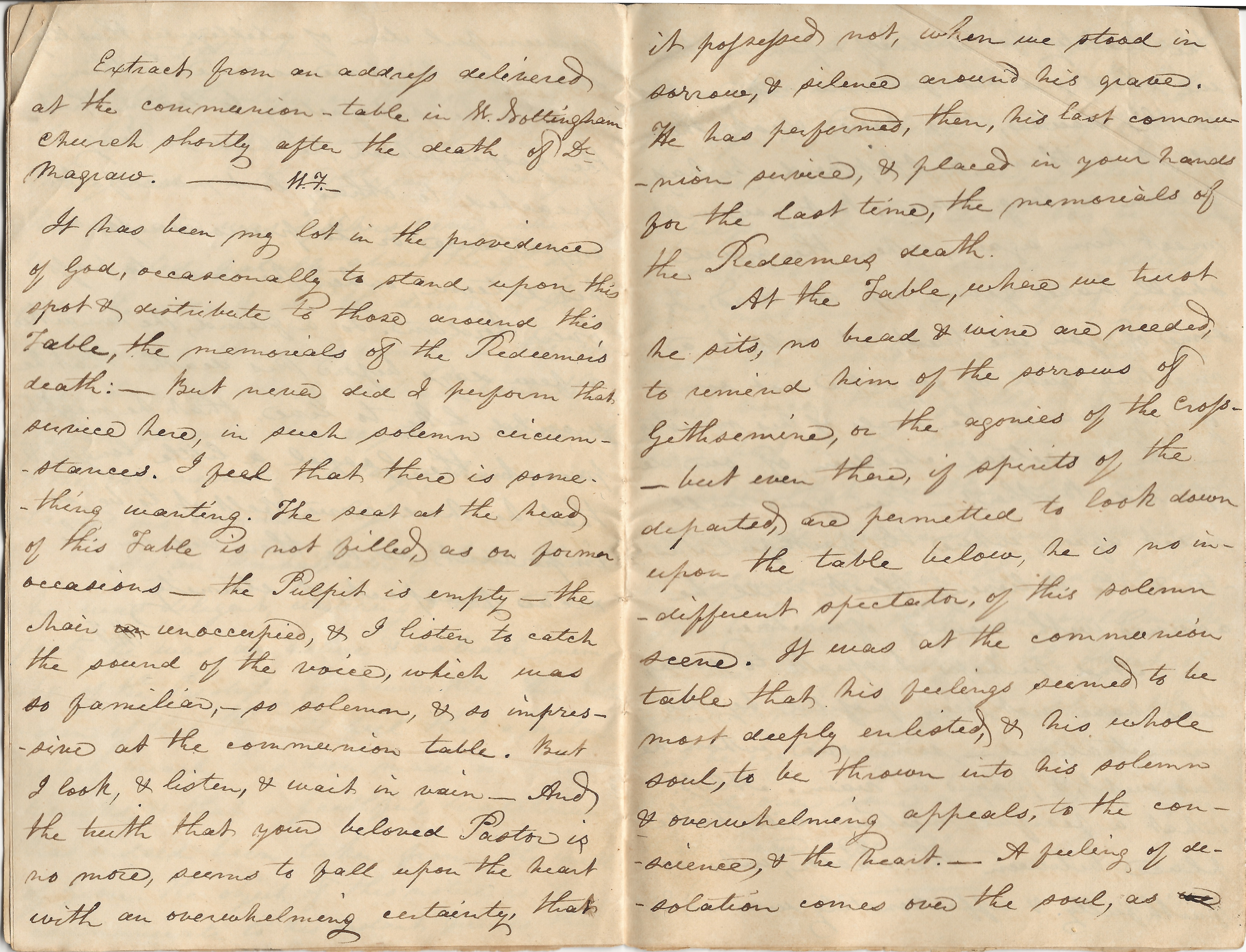
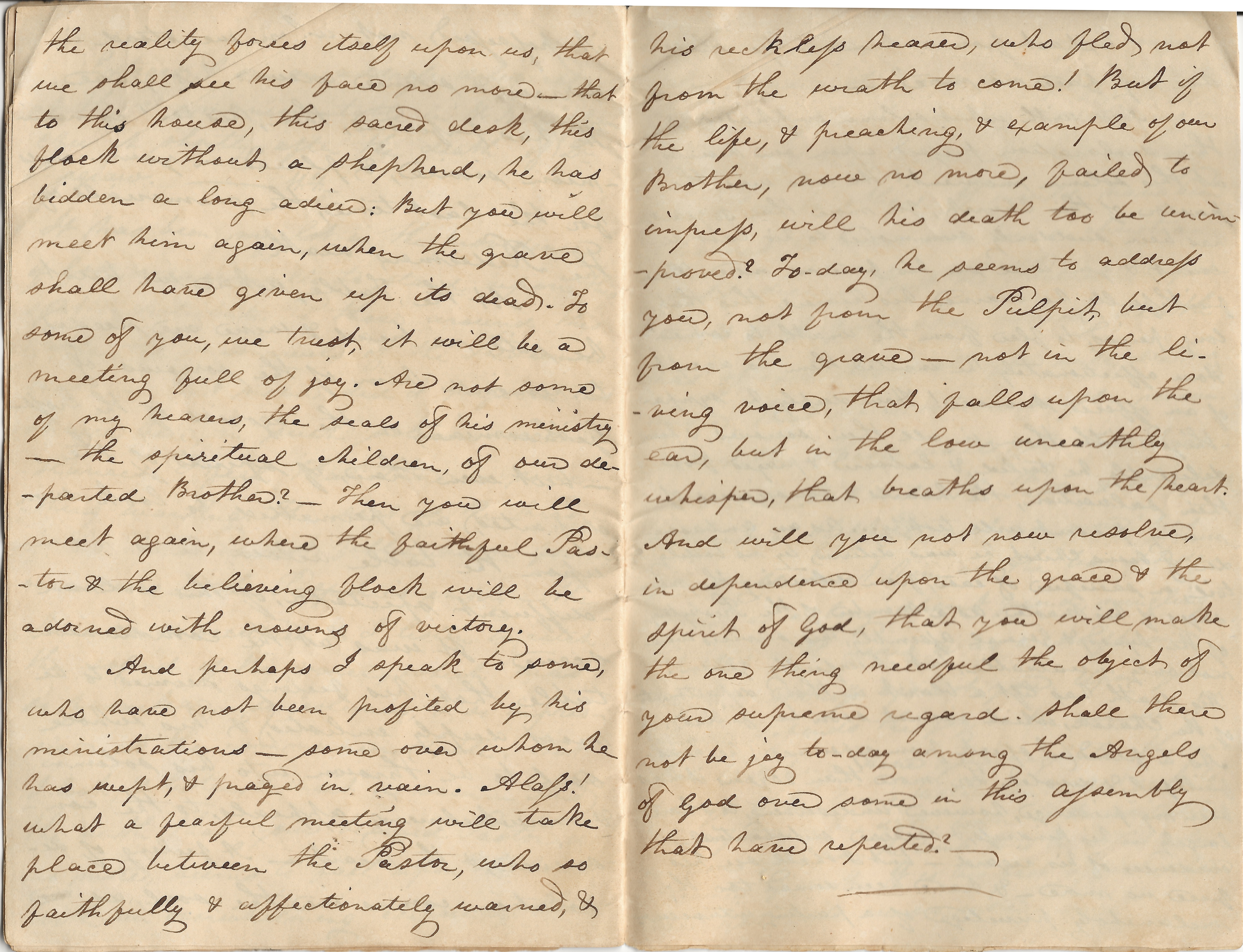
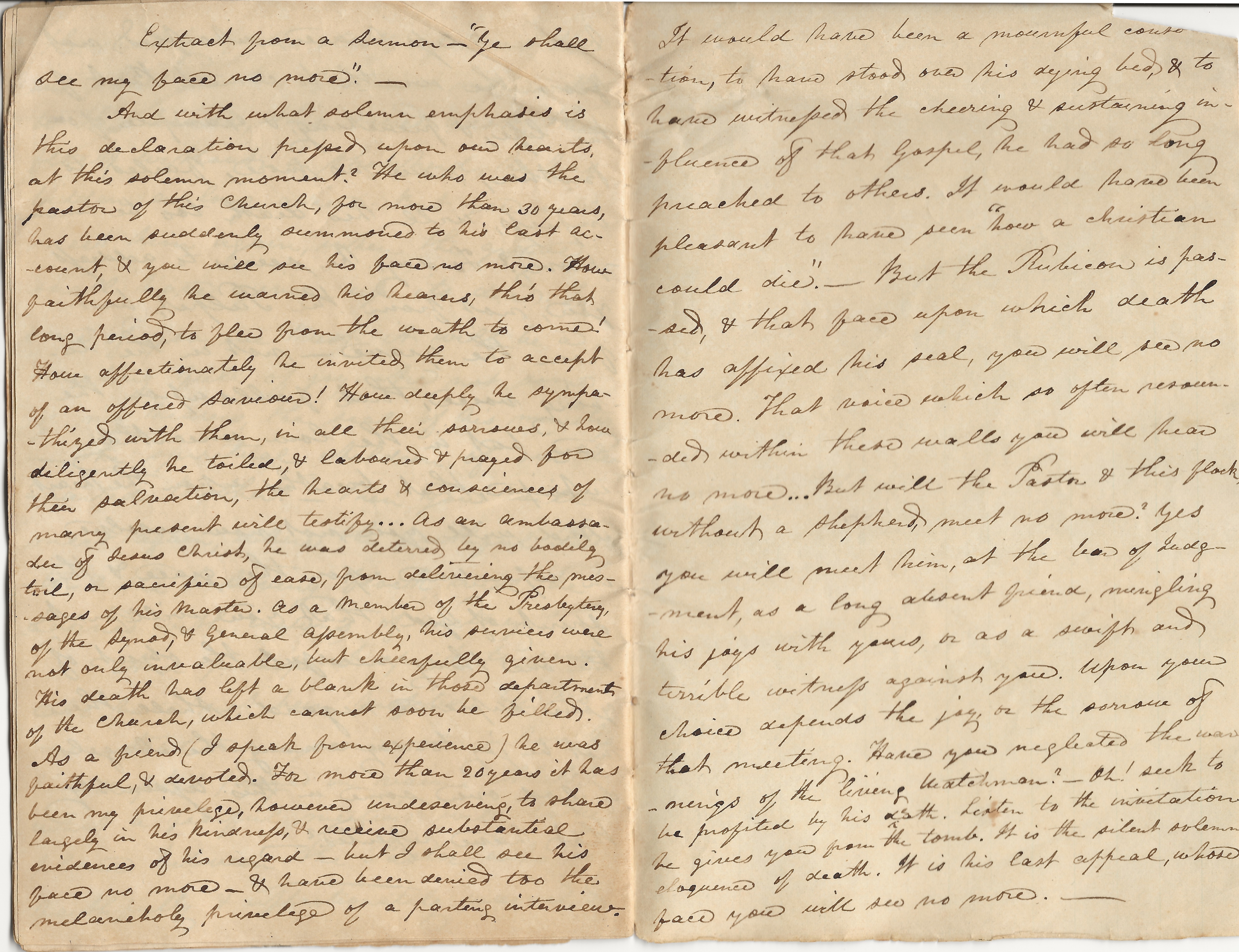
Rev. Finney sent Rev. McGraw’s son, Stephen, the following cover letter with a booklet containing copies of the eulogies delivered at Rev. and Mrs. Finney’s funerals, presumably by him, an obituary, and remarks made at the communion table to memorize Rev. Finney. The following are scans of the original documents followed by my transcription of them.
January 24th, 1844 Mr. S. J. Magraw Dear Sir—I have often regretted that so little that is permanent has been put on record in relation to your Father & Mother. I beg leave to suggest, if you think it worth while, that you would send what I have written to your sister, & let her write a copy for each one of her Brothers—at any rate a copy for William [William was apparently named after Rev. Finney]. I have copied what I promised and a little more—supposing it would not be unacceptable. The date at the top of the 6th page you can supply. I recollected the month but not the day of the year [the date, the 1st, was added on page six]. Any other mistakes you may notice please to correct. Sincerely yours, W. Finney
Substance of an address delivered at the funeral of Mrs. Rebecca Magraw. We have assembled to pay the last duties of affection, to one whose loss will be long felt, & very long deplored. It is no common loss we have sustained — & yet it is accompanied with consolations, of no ordinary kind. “The wicked is driven away in his wickedness, but the righteous hath hope in his death.”_ The lifeless clay which we have just covered up, ’till the last trump shall sound, was animated by a spirit, which we trust, has winged its way to the paradise above. Around this hope, hang no misgivings. We cannot, surely, be mistaken. The meek and peaceful spirit of the gospel, was strikingly & uniformly manifested in her whole deportment. Her example was noiseless, but impressive. Like
the “Dew of Hermon” [Psalm 133; Mt. Hermon] it distilled its refreshing influence, upon the circle in which she moved. Her calm & peaceful view of eternity, as she gradually approached its brink, & her expressions of confidence in the pardoning blood of Christ, were sure and comfortable evidences that the departing spirit was fitted for its flight. How consolatory to survivors, is the sweet assurance that death to her was gain! And who would not on, witnessing the peace of her expiring moments, & the hallowed calm that was thrown around her death-bed exclaim — Let me die the death of the righteous & let my last end be like hers!__
We have stood around the grave, & have committed to its trust, the precious but lifeless remnant, of the beloved, inestimable woman who had long been united to many of us, by sacred & tender ties. These ties have been dissolved, and the deathless spirit of our departed friend, has bidden us a long adieu. To the bereaved partner of her joys and sorrows, a crowd of consolations calculated to calm. The tumult of his feelings, are presented in the single fact that she sleeps in Jesus. What a privilege to have been the husband of such a wife! And altho’ a feeling of desolation, & loneliness must pass over his soul, it is his unutterable privilege to look beyond the lowering cloud, to the bow of the covenant beyond it, & exclaim, “The Lord gave and the Lord hath taken away. Blessed be the name of the Lord.” And while it is his privilege thus to bow, in peaceful submission,
to the sovereign will of God, how overwhelming are the motives presented in this scene of sorrow, to denote the short remnant of his span, with increased & redoubled diligence, to the care of that deathless spirit committed to his trust, & which in a little while must begin its eternal flight. By the children of our departed friend, the solemn transactions of this solemn day, will not — cannot be soon forgotten. You have looked into a mother’s grave, yes, a mother’s grave. It is the voice of a beloved, departed mother, whose living form you will see no more, & whose prayers for her children had so often ascended to the throne, in agonizing earnestness, that now addresses you from the tomb, and tells you to prepare to meet your God. Can you resist an appeal so overwhelming — an appeal so calculated to thrill upon every cord, and every fibre of the heart? And will you not in this hour so full of solemn, & tender recollections, resolve that you will seek with an earnestness, never felt before, the favor of a mother’s Covenant God, & prepare to follow in the wake of her deathless spirit, departed for the skies? __ W. F._
Notice, published in the newspaper— Departed this life on Monday Dec. 1st after a distressing & protracted illness, Mrs. Rebecca Magraw, wife of the Reverend Jas. Magraw, DD of Cecil County, Md, in the 55th year of her age. It is not intended in this notice to give in detail the history of her life, but merely a brief memorial. It is not known to the writer at what period in life she gave up the world for Christ. It is most probable however that it was in her youth. For many years she was a consistent & exemplary member of the visible Church & deeply interested in the general prosperity of Zion. In all the benevolent efforts of the day, she manifested a deep and increasing interest to the last. And if any one Christian enterprise shared in her affections more largely than another, it was the training up of young men for the gospel ministry. And some of them now in distant fields of labour, should they read this little memorial, will feel that they have indeed lost a mother — & the tear of gratitude will fall as memory brings up her kind attentions & untiring efforts to help them forward to the sacred office. As a wife she was yielding, affectionate & kind — as a mother a rare example of devotedness to the best interests of her children — as a friend decided and ardent in her attachments. The meek and peaceful spirit of the Gospel threw a moral charm over her whole deportment.
Her example was noiseless but impressive. It shed like the dew of Hermon its refreshing influence upon the circle in which she moved. Her calm and peaceful view of eternity as she gradually approached its brink — her expressions of confidence in the pardoning blood of Christ, were sure and comfortable evidences that the departing spirit was fitted for its flight. As her end drew near, she was asked by a friend if Christ was precious — precious! she exclaimed as if surprised at the question: “He is my whole dependence!” Death when he came created no alarm. She felt the gentle intimation that her hour was come; & clasping her hands upon her breast, & raising her eyes to Heaven in a fixed & ardent gaze resigned her spirit unto God who gave it.
“So sets the morning star, “Which goes not down behind the darkened West, “Nor hides obscured ‘mid tempests of the sky, But melts away into the light of Heaven.” [poem; text]
Extract from an address delivered at the communion-table in W. Nottingham Church shortly after the death of Dr. Magraw — W. F. It has been my lot in the providence of God, occasionally to stand upon this spot & distribute to those around this Table, the memorials of the Redeemer’s death: — But never did I perform that service here, in such solemn circumstances. I feel that there is something wanting. The seat at the head of this table is not filled, as on former occasions — the Pulpit is empty — the chair unoccupied, & I listen to catch the sound of the voice which was so familiar, — so solemn, & so impressive at the communion table. But I look, & listen & wait in vain — And the truth that your beloved Pastor is no more, seems to fall upon the heart with an overwhelming certainty, that is professed not, when we stood in sorrow, & silence around his grave. He has performed, then, his last communion service, & placed in your hands for the last time, the memorials of the Redeemer’s death. At the table, where we trust he sits, no bread & wine are needed, to remind him of the sorrows of Gethsemane, or the agonies of the Cross — but even there, if spirits of the departed, are permitted to look down upon the table below, he is no indifferent spectator, of this solemn scene. It was at the communion table that his feelings seemed to be most deeply enlisted, & his whole soul, to be thrown into his solemn & overwhelming appeals, to the conscience, & the heart. — A feeling of desolation comes over the soul, as
the reality forces itself upon us, that we shall see his face no more — that to this house, this sacred desk, this flock without a shepherd, he has bidden a long adieu: But you will meet him again, when the grave shall have given up its dead. To some of you, we trust, it will be a meeting full of joy. Are not some of my hearers, the seals of his ministry — the spiritual children of our departed Brother? — Then you will meet again where the faithful Pastor & the believing flock will be adorned with crowns of victory. And perhaps I speak to some who have not been profited by his ministrations — some over whom he has wept and prayed in vain. Alas! What a fearful meeting will take place between the Pastor, who so faithfully and affectionately warned, & and his reckless hearer who fled not from the wrath to come! But if the life, & preaching and example of our Brother, now no more, failed to impress, will his death too be unimproved? To-day, he seems to address you, not from the Pulpit, but from the grave — not in the living voice, that falls upon the ear, but in the low unearthly whisper, that breaths upon the heart. And will you not now resolve, in dependence upon the grace & the spirit of God, that you will make the one thing needful the object of your supreme regard. Shall there not be joy to-day among the Angels of God over some in this assembly that have repented?
Extract from a sermon — “Ye shall see my face no more.” — And with what solemn emphasis is this declaration pressed upon our hearts at this solemn moment? He who was pastor of this church, for more than 30 years, has been suddenly summoned to his last account, & you will see his face no more. How faithful he warned his hearers, thro’ that so long period, to flee from the wrath to come. How affectionately he invited them to accept of an offered Savior! How deeply he sympathized with them, in all their sorrows, & how diligently he toiled, & labored & prayed for their salvation, the hearts & consciences of many present will testify . . . as an ambassador of Jesus Christ, he was deterred by no bodily toil, or sacrifice of ease, from delivering the messages of his Master. As a member of the Presbytery, of the Synod, and general assembly, his services were not only invaluable, but cheerfully given. His death has left a blank in those departments of the Church, which cannot soon be filled. As a friend (I speak from experience) he was faithful, & devoted. For more than 20 years it has been my privilege, however undeserving, to share largely in his kindness, & receive substantial evidences of his regard — but I shall see his face no more — & have been denied too the melancholy privilege of a parting interview. It would been a mournful consolation, to have stood over his dying bed, & to have witnessed the cheering & sustaining influence of that gospel, he had so long preached to others. It would have been pleasant to have seen “how a Christian could die.” — But the Rubicon is passed, & that face upon which death has affixed his seal, you will see no more. That voice which so often resounded within these walls you will hear no more . . . but will the Pastor & his flock without a shepherd, meet no more? Yes you will meet him, at the bar of judgement, as a long absent friend, mingling his joys with yours, or as a swift and terrible witness against you. Upon your choice depends the joy or the sorrow of that meeting. Have you neglected the warnings of the living Watchman? Oh! seek to be profited by his death. Listen to the invitation he gives from the tomb. It is the silent solemn eloquence of death. It is his his last appeal, whose face you will see no more. ——
February 2022 update: My wife gets me out of my urban canyon on weekends by taking me on a discovery drive out in the county (outnacanty) and today we came across the monument to Reverend Finney mentioned above. We stopped for a photo:
The monument to Rev. Finney by the Baltimore sculptor Hugh Sisson faces the front door of the Churchville Presbyterian Church, 2844 Churchville Road, Churchville, MD
The couple pictured above are Naomi Ada Myers (1891-1971) and her husband Edward Morrison Wantz (1886-1972) who resided in Pleasant Valley, a village in the vicinity of Westminster in Carroll County, MD.
Naomi was the oldest child of the five children of Upton Harvey “Uppie” Myers (1865-1936), a huckster, and Alice Catherine Motter (1863-1940) who married in 1890. Edward was the oldest of the 11 children of George Zephenia Wentz (1863-1921), a farmer in Uniontown, MD, and Mary Ann Helwig (1866-1949). Generally speaking, the name Wantz was rendered Wentz until Edward’s generation, but many times both spellings were used for the same family.
Naomi and Edward were married in the Lutheran Parsonage at Silver Run, MD, on 24 January 1911. They had two children. First came Margaret C. Wantz (1912-2001) who married James Norman Brown (1910-1990) in 1933 and had three children. Next came Richard Edward Wantz (1914-2002) who married Portia Virginia Crabbs (1919-2004) and had one child.
Wantz-Myers Wedding Announcement (The Democratic Advocate, Westminster, MD, 27 January 1911, p. 8)
Edward was a farmer, carpenter, furniture maker, and businessman buying and selling farm land and equipment. He served on the boards of the Union Mills Bank and the Westminster Trust Company which were among the predecessors of PNC Financial Services. Edward was also a founding member of the Pleasant Valley Community Fire Company. Edward was a charter member of the Pleasant Valley Cemetery Association, the cemetery where he and Naomi are buried, as are Margaret and Richard and their spouses.
Naomi and Edward were members of St. Matthew’s United Lutheran Church in Pleasant Valley and following is the church’s annual report for 1919. (You can download a .pdf of the report here.) Edward was presented with the first life membership in the church’s history in 1961. According to the history of St. Mary’s Evangelical Lutheran Church in Silver Run, which traces its origin to the unification of Lutheran and Reformed churches in 1762, St. Matthew’s Lutheran Church in Pleasant Valley was founded and 1879 and joined St. Mary’s in a two-church parish, a relationship which lasted until 1990. In 1991, St. Matthew’s Lutheran Church and St. Matthew’s United Church congregations, which were using the same building in Pleasant Valley, united to become St. Matthew’s United Church of Christ at Pleasant Valley. It gets a little confusing, but some understanding can be gained from this this Wikipedia entry about the United Church of Christ.
Annual Report of St. Matthew’s United Lutheran Church at Pleasant Valley, Md for the year 1919, cover
Annual Report of St. Matthew’s United Lutheran Church at Pleasant Valley, Md for the year 1919, page 2
Annual Report of St. Matthew’s United Lutheran Church at Pleasant Valley, Md for the year 1919, page 3
Annual Report of St. Matthew’s United Lutheran Church at Pleasant Valley, Md for the year 1919, page 4
Annual Report of St. Matthew’s United Lutheran Church at Pleasant Valley, Md for the year 1919, page 5
Annual Report of St. Matthew’s United Lutheran Church at Pleasant Valley, Md for the year 1919, page 6
Pleasant Valley, MD and surroundings in 1877 (Atlas of Carroll County, Lake Griffing & Stevenson, 1877)
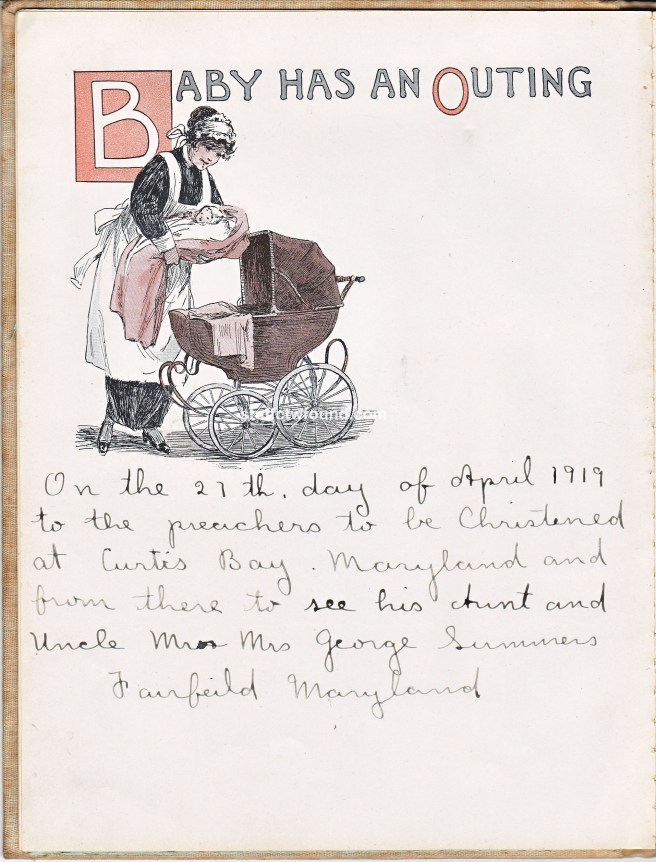
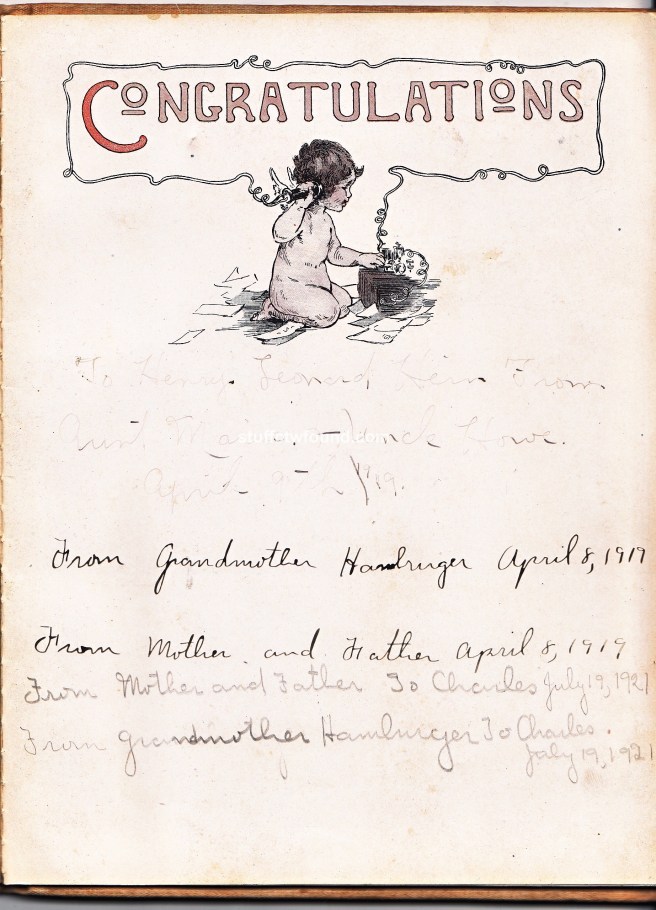
I found the baby book for the brothers Henry Leonard Hein (1919-2006) and Charles Leroy Hein (1921-2010) in an antique store in the Baltimore neighborhood of Hampden in early 2016. Here is the front cover:
Their parents were Ernest Henry Hein (1898-1960) and Louise Irene Hamburger (1898-1993). They had a sister, Irene J. Hein (1924-2016) who married Alfred J. Lipin (1920-2012). All three children grew up to be very accomplished, civic-minded adults and important members of the Glen Bernie, MD community. You can read their obituaries here: Henry, Charles, and Irene.
Ernest’s parents were John Hein (1865-??) and Anna Catherine Grothy (1864-1926) who were born in Germany, married in 1887, and arrived to the USA in 1888. Online records create a confused mess of the family’s genealogy. John appeared in the 1900 Census. By the 1920 Census Anna, AKA Annie, had been married to Adolph Schohl (1873-1956) for five years. In the 1920 Census all seven of John’s children were enumerated with the surname Schohl. Adolph and Anna had two children together. One key to getting to the bottom of this is that Anna’s son John G. Hein (1890-1920) is buried near his mother in the Schohl plot at Cedar Hill Cemetery in Brooklyn Park, MD. According to contemporaneous accounts in The Baltimore Sun, in January 1926 Anna was beaten by someone who robbed her grocery store located on Annapolis Boulevard a mile north of Glen Bernie, MD and died of a fractured skull a few days later. The murderer was never caught.
The nurse on the below page, “Lizzie Hamburger”, was maternal grandmother to the boys, Elizabeth J. UNKN (1859-1930) who married Andrew Leonard Hamburger (1861-1918) in 1897. Both of them were born in Maryland
That Andrew Leonard Hamburger’s middle name is Leonard can be confirmed only by the following page and not by any online records I could find. Charles’ uncle for whom he was named was actually named Charles Lawrence/Laurence Hein (1899-1967) according to the one record I can find, his WWI draft registration in which the name is written as Lawrence but corrected by a recent researcher to Laurence. I found no one else named Leroy during my brief examination of the family’s genealogy.
Here is a photograph of Henry and his parents from June 1919.
Here are two locks of Henry’s hair taken from this first and second haircuts. As frequently happens, the parents’ enthusiasm for this sort of detail waned after the first child.
The Mr. and Mrs. Summers referred to below were Ernest’s sister, Marie Hein (1893-1980) and her husband George Wilson Summers, Sr. (1888-1953).
The baby book used was illustrated by Meta Ann Morris Grimball (1878-1968). If you’re a Pinterest person you can see a large sample of her work here.
The following images are the remaining pages in the book and the back cover.
In the late 1980’s my children’s mother and I went to Bucks County, PA to visit her grandparents, Bernard Woodrow Lawhon (1913-1988) and Ruth Virginia Davie (1913-2002), on a day when their sons were helping them clean out their garage in preparation for a move.
On that day I acquired a family Bible which was inscribed as you see above. I do not know how Ruth came to possess the Bible, but she was bookish and intellectual so it is no surprise that she saved it from ruin. There was no family connection that I have been able to detect. Between the pages of the Bible were several newspaper clippings, and there was a very nice “Family Record” page.
It is a mystery to me that a small bunch of documents remain together through who-knows-what-all turbulence and upheaval to be found by me in an antique store. I mean, I know how it happens, technically: someone dies; someone wants to dispose of unwanted possessions; someone performs the service of removing that stuff; someone tries to make a buck buy selling it to me. The mystery is that of all the documents associated with a life, these few somehow come through. Whatever fates made it possible, I’m glad to have spent a few hours looking back at Carrie’s world 83 years ago.
When Mrs. Carrie V. McKnew Day Cramblitt (1866-1937) wrote her step-daughter, Mrs Hilda May Cramblitt Klages (1896-1970) on 25 August 1933 it was a little over three months after the death of her husband and Hilda’s father, Arthur T. Cramblitt (1861-1933) and two days after a horrific hurricane struck the Maryland and Virginia coasts.
Leonard Walton Cramblitt (1884-1942) and Walter Dewitt Cramblitt (1888-1948) were Hilda’s brothers. Another brother, here unmentioned, was Robert Moore Cramblitt (1888-1865). Carrie was not the biological mother of these Cramblitt children, having married Arthur T. Cramblitt in 1918. The children’s mother, Molly/Mollie Moore, died in 1899. Arthur, Mollie, and Carrie are buried together in Mount Olivet Cemetery, findagrave.com memorials 34413134, 34413140, and 34413135.
Arthur T. Cramblitt was a carpenter. It is easy to imagine that their house in Cedarhurst on the Bay was filled with “the work of his hands.”
Carrie’s description of the storm might seem exaggerated but contemporary descriptions in the Baltimore Sun prove it was quite severe. An editorial on 24 August said, “A wind of violence unequaled in recent memory tore into the beach resorts of Maryland and Virginia and immobilized all water traffic inside the Capes.” A 4 September story reported that MD Governor Ritchie had tasked State Conservation Commissioner Swepson Earle (his obit) to assess the damage. Earle reported hundreds of Chincoteague Island ponies had drowned, leaving only three, and that erosion caused by the storm resulted in the loss of about 1200 acres of land.
I don’t know who Pauline is, probably a neighbor. Shady Side would have been the location of the nearest post office.
Carrie listed her address on the back of the envelope. In the 1930 Census she and Arthur were listed as residents there and her biological son, Milton R. Day, was the head of household.
The other documents in this small batch were associated with Hilda:
A certificate of the marriage of Hilda May Cramblitt to Vernon Charles Klages (1894-1945) on 6 June 1918.
A certificate attesting to Hilda’s confirmation by John G. Murray, Bishop of Maryland.
A couple of letters and documents pertaining to Vernon’s death and burial. Vernon died on 16 August 1945 after the E.H. Koester Baking Company truck he was driving struck a streetcar on Hanover Street in south Baltimore. Hilda tried to sue the E. H. Koester Bakery and the Baltimore Transit Authority for damages. Hilda’s lawyer dropped her case after George Pollar, a passenger on the streetcar, lost his own suit on appeal in 1947 because the court found that Vernon was responsible for the crash.
Venice Etta Thayer (1895-1978) was the daughter of Herman Thayer (1865-1945) and Clara A. Thompson (1870-1948). Charles Herman Thayer (1903-1997) was her brother.
Venice married Fremont Phiness Steward (1895-1982) in 1915 and they apparently had one child, Doctor Edith Etta Steward (1927-2008) who died in CA.
Here is a photograph of the Thayer family tombstone in Whitefield Cemetery, Whitefield, ME:
I picked up this postcard at Strawberry Fields off The Avenue in Hampden, Baltimore, in late 2015. It was apparently never mailed.
There were five other postcards in the box which Venice had received from others. The most interesting of those was this one depicting the brand new Waterville Senior High School which was placed on the National Register of Historic Places in 2010. Venice’s unnamed correspondent marked a window with an “X” where she had place a banner.
These postcards were in a box with a bunch of stuff associated with a Baltimore area family and I have not yet discovered the connection between that family and the Thayer family of ME. Perhaps there is no connection and they were mixed in with that bunch by fate. As I work through the box perhaps a connection will be revealed.
The following letter is one of two I bought on The Avenue in Baltimore at Millbrook Antiques & Prints in October 2015. I did a little genealogical research on the family. Please contact me if you’re interested in further information, or if you would like to own the original letter.
The town of Cato Four Corners is now known as Meridian and is located in Cayuga County, NY.
Here is my transcript of the letter:
[Address on the front]
Mr. Frederick Moul
Cato Four Corners
Cayuga Co., NY
Sand Lake, NY
[Page 1]
January the 1, 1836, Sand Lake
Dear Cousin,
I take this opportunity to write to you that I am well at present and hoping these few lines will find you enjoying the same blessing. I have just left aft working for Mr. Hillard yesterday. Now I am uncle Henry and expected our folks after me but has been so stormy they did not come. I am now going to work about the neighborhood. I should be very much pleased to see you all but if I never see you on earth I hope to meet you in a better world than this.
Eliza Moul
Margaret Moul
Dear Cousins,
It is with much pleasure that I embrace this opportunity of writing a few lines to you on this storm New Years evening, being very comfortably situated in our room and thinking you had forgotten us. We would remind you of what you promised when last we parted. My health with the rest of our cousins is good at present. Hoping these few lines through the goodness of God will find you enjoying the same blessing. Dear cousins, I should be pleased to see you all yet we re at some distance from one another so that we cannot visit as we once did although we can recollect the past enjoyments we have had together, but know not that we shall ever enjoy them again on the shores of time. How important it is that if we meet no more on earth that we be prepared to meet in heaven. My best respects to you all.
Mother sends her best respects to your mother and says she would be pleased to see her. Her health has been very good this summer. Write to us as soon as you can.
Your Affection Friend,
Abigail Moul
[Page 2]
Sand Lake, January the 1 1837
Thomas M. Moul
Dear Uncle,
On this ((snowy)) day being new years day I take this opportunity to inform you that we through the goodness and mercies of god are enjoying tolerable good health which I think is the greatest temporal blessing on earth and hoping these few and broken lines will find you enjoying the same blessing. We have not heard from you since we received your letter. Your mother has been very unwell this last fall so that they sent up word father and uncle Peter and Jacob went down, but she has recovered her health again. Also, ((Mary)) has been sick but has gotten better. I have been down since and grand mother has been very much grieved thinking that you did not come and see her before you removed to the west. Grandma Measick is very sick the last that we heard from her. I suppose that you have heard that Sally is married. Cousin Frederick has bought a farm not far from the lower aqua duct. Father says that you must come down and he will go with you to Rhynebeck [Rhinebeck]. You must write us a letter how the prospects are there and how your crops were last summer and whether you think we had better sell yet or not. Thomas Measick offered us 50 dollars an acre for our farm. Charles and Hannah has been down and stayed with us one night and were all well. The rest of our friends are well as far as I know of. The snow fell about 15 inches on new years day.


 I first thought the author’s given name was Alvin and did find three newspaper articles about a railroad man named Alvin Willey in York, but there were dozens more about Albert Willey (1845-1888). Albert turned out to be Levin Willey’s son, and “Alvin” turned out to be an apparent combination of Albert and Levin. Albert was a distinguished railroad man himself, but he sold out and moved his family to Philadelphia where he died in 1888 leaving a widow and three children. At the time of his death he was the switch tender at the tower at [N] 52nd Street.
 Finally, Levin informed his brother that “Nat Johnson has got his second wife. Nat owns the mill which belonged to my father and is making money.” That mill is now known as Abbott’s Mill. Levin’s father was Nathan Willey (1775-1812). According to a Fall 1984 article in The Archeolog, the mill to which he refers is now known as Abbott’s Mill Nature Center in Millford, DE.