The above photograph depicts the class of the public school in Frizzellburg, Carroll County, MD, in May 1932. I bought it from an antique store in Baltimore, MD. The teacher at the school in 1930 was Marian Ruth McAllister (1910-1987) who taught in the Carroll County Public Schools for 31 years. I am assuming that’s her in the center of the back row and hoping someone will confirm that. She married John Clifford Schaeffer, Sr. (1899-1987) in 1937 and they had four children. The following Evening Sun (Hanover, PA) photograph shows Marian in July 1973 when the Carroll County Board of Education presented her and other retired teachers and administrators with engraved silver bowls:
Marian Ruth McAllister Schaeffer is back row, far right
There isn’t a lot of Frizzellburg history to be obtained online when one is confined to the home office, so I’ll borrow a short history from the Historical Society of Carroll County Facebook page:
A bit of history from Frizzellburg – – On April 17, 1814, Nimrod Frizell married Ann Fischer Frizell and moved into the area. He first built a home and opened a blacksmith’s shop. A short while later he built another house, this one large enough to house his family as well as serve as an inn and a small general store. Frizell’s Tavern was one of the few places along the way to western Maryland that accommodated travelers. It lay on the road that linked the bustling Baltimore area and the rural towns west of it. The Frizell family became so active in local affairs that the settlement became known as ”Frizzells” (with an added Z). The name was formally changed to Frizzellburg later. This road is said to have been made of 2″ x 10″ x 14′ planks, placed crossways on heavy beams or timbers as supports in the soft dirt of the highway.
The photos show that Frizell’s Tavern stands today and is very closely restored to its appearance in 1818. Next door stands a fieldstone house which was the later home of the Frizell family when they moved from the second floor of the tavern. Nimrod and Ann Frizell are buried in the Westminster Cemetery.
Alfred Warner built a general store fronting the road in the 1860’s to serve the needs of the community. It’s now the Frizellburg Antique Store and stepping inside is like stepping back in time. Frizzellburg was also the home to a handsome brick school shown in an 1888 photo from the collection of the Carroll County Genealogical Society.
In 1997 when a feature article was written about Frizzellburg in the Baltimore Sun, about 70 families resided in the heart of the community, living in homes built seemingly to last forever. Typically, a Frizzellburg home has a log structure hidden behind modern walls which are meticulously maintained down to the neatly trimmed flower beds and backyard vegetable gardens.
The Family of Peter A. Diehl (1841-1907) and Mary A. Schnell (1846-1921), 1905
I copied the above photograph with my phone because the original is too big for my scanner. It was purchased in late 2020 from an antique store in Baltimore, MD. At the bottom is an image of the 8.5 X 11 inch piece of paper glued onto its back
Peter A. Diehl (1841-1907) and Mary A. Schnell (1846-1921), seated next to each other in the center of the middle row, were both natives of York County, PA. They were married in 1860 and lived in Hopewell Township, York County, PA. His parents were Levi Diehl (1816-1901) and Juliann Klinefelter (1816-1885), and her parents were Jacob Schnell (1815-1902) and Catherine Keller (1815-1897), all natives of Pennsylvania. Peter’s obituaries described him as “prosperous” and said his estate was valued at over $20,000 (~$557K). The note on the back states the photograph is dated 1905, but I think it’s 1906 because the youngest child pictured was born in February, 1906. The family members, their Find A Grave memorial number, if known, and their birth-death dates are listed below:
Eli B. Keller, 49932969, (1865-1938), 2nd Son-in-Law
Harry Diehl, 96842816, (1865-1936), 1st Son
Zeno Diehl 96842991, (1889-1955)
Navin McWilliams, 123613598, (1891-1958)
James McWilliams, 114306764, (1867-1945), 1st Son-in-Law
James Emory Diehl, 160242424, (1878-1958), 2nd Son
Mildred Diehl, (1906-1973)
Family Groups:
Peter A. Diehl (9) married Mary A. Schnell (10) in 1860 and their children were Harry Clinton Diehl (15), Bertha May Diehl (1870-1953) (11), Zana Irene Diehl (1873-1963), and James Emory Diehl, Sr. (19).
Harry Clinton Diehl (15) married Sarah Jane Herbst (8) and their children were Zeno M. Diehl (16) and Leonard Hastings Diehl, Sr. (1). Harry was the senior member of the firm H. C. Diehl and Son, butchers in Loganville, PA.
Bertha May Diehl (11) married James F. McWilliams (18) in 1891 and their children were, Navin D. McWilliams (17) and Mary Etta McWilliams (5). Bertha raised her family in Shrewsbury, PA
Zana Irene Diehl (7) married Eli Benjamin Keller (14) in 1892 and their children were Russell Conwell Keller (6), Treva Margarite Keller (2), Jarius B. Keller (3), Kenneth A. Keller (4), and Harold Diehl Keller (13). Zana raised her family in Glen Rock, PA.
James Emory Diehl, Sr. (19) married Annie V. Shirey (12) in 1900 and their children were Mildred Louisa Diehl (20) and James Emory Diehl (1912-1997). James was the proprietor of D&D Sewing Company, York, PA.
Reverse of The Family of Peter A. Diehl (1841-1907) and Mary A. Schnell (1846-1921), 1905
There are a lot of interesting facts about the family, but there are too many people to profile in this space. I do want to share the following account of the death of Peter’s mother in 1885, just because. I was unable to find a report of of her funeral.
The above photograph shows a U. S. Navy airship over Guantanamo Bay, Cuba. The date of the photograph is unknown. It appears to have been taken from aboard a ship.
The U. S. Navy’s first airship was the DN-1 which first flew in April 1917. The Navy flew dirigibles out of McCalla Field, Cuba which was operational from 1931-1970. I am not certain of the perspective because I can’t determine if photographer meant to depict his own entrance to the bay or the dirigible’s entrance. Judging by the ships visible in the distance, I can see at least four, the photographer could be northwest of the airfield.
Guantanamo Bay, Cuba (Google Earth, 2004)
This photograph was purchased from a Baltimore antique shop in November 2020.
The above photograph depicts the Forster family of Philadelphia. We know the names of people in the photograph and where it was taken because of a type-written note on its reverse. It was purchased at an antique/junk store on in the Hampden neighborhood of Baltimore, MD.
Heinrich Joseph Eduard Adolph Fäster (1817-1891), later Forster, and his wife, Eleonore Dorette “Dorothea” Henrietta Klieves (1822-1913), immigrated from Germany to the USA separately. I don’t know when or how Adolph got here. Dorothea was single when she arrived in to the Port of Baltimore in 1841 aboard the S.S. Caspar sailing out of Bremen, Germany. Immigration documents say she “originated” in Nienover.
Adolph’s occupation in 1850 was “looking glass maker” and the family lived in Philadelphia’s Pine Ward. We know from Census records and Adolph’s obituary that the full address was 421 S. 2d Street, now the site of a CVS. Adolph’s other recorded occupations were “variety store” owner, “toy maker,” and proprietor of Adolph Forster & Company which imported toys and dolls from Germany.
Of their children, the first born was Amilie Louise Forster (1845-1928). She never married and no occupation was listed on her death certificate.
Second born was Emma Augusta Forster (1846-1934). She married German-born Henry Bauermeister (1837-1904) who was a toy importer. When I learned that Emma married a Bauermeister, I remembered the box I got the above photograph from contained a photograph of the Bauermeister family in Germany, so I went back to the store and found two versions of it.
Third born was Josephine Doris Forster (1848-1938). Josephine also never married though her death certificate lists her occupation as “housewife.” Her obituary asked that “Wheeling, WV papers please copy,” but I was unable to figure out the reason.
The fourth born was George Forster, in September 1852, and he is not in the photograph. He lived at least until age 18 when he was enumerated with his family in the U. S. Census of 1870, but I found nothing more about him.
Fifth born was Wilhelm “William” Heinrich August Forster (1859-1939). William followed in his father’s footsteps as an importer of toys and dolls from Europe and apparently renamed the business after himself. William never married. When he died he left his estate of $70,000 ($1,311,306.47 in 2020 dollars) to four nieces who lived in Baltimore, Olga Marie Wacker (1899-1961), Ilse Forster Wacker (1904-1962), Dorothy Forster Wacker (1895-1989), and Carla Wacker (1908-1985).
Those Wacker girls were among the children of the sixth child, Cecelia Louisa Forster (1864-1927). She married German-born Charles N. Wacker (1847-1921) in Philadelphia in 1893. By 1900 they had moved to Baltimore and Charles was working as a ship chandler. Charles’s obituary informed that he was “engaged in the canning business in Maryland” for many years. Here is the best version of the photograph I went back to the store to get:
Caption on the reverse: Picnic in Bremen, Celia (sic) Forster with Bauermeister Family
The owner of the antique/junk shop where I bought these materials called me back a week or so after I obtained the above photographs to tell me about the availability of some actors’ head shots in a box of papers at the shop. I went over to have a look and found four photographs autographed to Stanley Broughton Tall, Sr. (1891-1966), a Baltimore playwright whose second wife was Dorothy Forster Wacker. Tall was born in Baltimore County, MD to Otis Jackson Tall (1866-1920) and Onia Broughton (1865-1917).
Tall’s obituary in The Evening Sun described him as a “versatile dramatist and public relations writer” who was a drama critic for that newspaper in the 1930s, a program director for WBAL, and a publicist for the Baltimore Symphony Orchestra. Tall self-published Pages From a Critic’s Note Book in 1913, which contained “the personal opinions of the writer concerning authors, plays, and players . . . written in true journalistic manner; the night of the play and in the night of the midnight oil.” Tall also formed Tall-Owens Publishing Company to publish a number of songs with him as the lyricist and one William Owens as the composer.
The actors whose autographed photographs follow performed in the premiere of Tall’s “Green Jade” in Dayton, OH in September 1921. I was unable to find a copy of the play but here is a review of that performance. A notice said it was expected to be the first play performed at the Times Square Theater in September 1920 with Florence Reed starring, but the theater opened with Reed starring instead in The Mirage and that ran for 192 performances.
To Mr. Broughton Tall with my sincere good wishes, Jane Stuart, “Green Jade,” 9-12-21
To Mr. Tall–Hope the play goes over big in N. Y., Sincerely, Frances Pitt
Francis Pitt was the daughter of the English actor William Addison Pitt (1876-1968) and Helen Agnes Schayer (1875-1959) and the grand-daughter of the actress Fannie Addison Pitt (1876-1968).
To Mr. Tall, In sincere appreciation of the opportunity of playing “Richard,” Corliss Giles
To Mr. Tall, a fellow Baltimorean, I wish the greatest success. The original “((Maz)),” Fraunie
“Fraunie” had a number of stage names but his true name was Francis Anthony Fraunholz (1883-1961). Fraunie was, like Tall, a Baltimorean, the son of a wood carver named John M. Fraunholz (1854-1936) and Catherine E. Parr (1863-1943). All four of his grandparents were born in Bavaria. His Wikipedia page has a list of films he appeared in between during 1913-1919 which I can’t vouch for given that Fraunie’s vital statistics are all wrong. In the 1930s Fraunie was the Bergen County, NJ director of the Federal Theater Project (1935-1939).
This blog was suspended for a few weeks as I tried to get my arms around some other projects, but one of those projects is pretty depressing, particularly in the current climate, so I spent a few days on this blog to clear my head a little. The photograph is one of a cache I received from a Stuff CTW Found field operative currently deployed to South Dakota.
Lucile Edwards When a tiny girl & Doll. Capa S. D.
The above photograph depicts Lucille Margaret Edwards (1914-2007). The caption on the back states she lived in Capa, Jones County, SD. The Census of 1920 enumerates her family as living on the Lower Brule Indian Reservation in Lyman County, SD. Easterners like me must rejigger their conception of distance when considering places like South Dakota.
Lucille’s father was Charles Erwin Edwards (1886-1971), a farmer, who was born in Wisconsin to Wisconsin-born parents. Lucille’s mother was Karolina Sophie “Lena” Kohler (1887-1925) who was born in Wisconsin to German-born parents. They were married in Lyman County in 1909.
Lucille married John Arthur Hansen (1913-1996) in February 1939 in Estherville, IA where he was born. John’s father was Jens “John” Hansen (1872-1947) who was born in Denmark. His mother was Andrea Husby (1886-1961) who was born in Norway. Jens was a tailor in Denmark and in Germany before moving to the USA in 1893. According to an obituary featured in his findagrave.com memorial, Jens bought out a tailor in Estherville in 1894 and added a dry cleaning plant in 1905. John followed his father in the dry cleaning business. Lucille and John had three sons.
Lucille and John both died in Hawaii and are buried near John’s parents in Oak Hill Cemetery in Estherville. There is a photograph of Lucille on her findagrave.com memorial page and you can see that she retained that dimple in her chin until adulthood. On her memorial page and on John’s memorial page there are several photographs of the family.
When and why did they move to Hawaii? I don’t know the answers for certain but I think it has something to do with Al Phillips (1907-1984). Known as Al Phillips the Cleaner, Phillips spent 40 years in the dry cleaning business in Oregon and Las Vegas before retiring and moving to Honolulu in 1964. Unable to remain retired, Phillips built an Al Phillips the Cleaner plant on McCully Street, then sold it in 1968. Lucille and John appear in a Portland, OR city directory in 1955 and John is working for Ideal Cleaners in Beaverton. They were still living in Portland in 1961, but in 1971 they were living in an apartment on McCully Street in Honolulu, the same street where Al Phillips built his dry cleaning plant. In my imagined scenario, Phillips knew John from Portland and recruited him to help set up the Honolulu edition of Al Phillips the Cleaner. John’s obituaries inform that he was retired from Al Phillips the Cleaner. Perhaps a family member will shed light on this story at some point.
Above we see Horace Greeley Reese, Sr. (1876-1954). I would bet a dollar that Horace was named after Horace Greeley (1811-1872) who was the founder and editor of the New-York Tribune, a member of the U. S. House of Representatives, and a presidential candidate of the Liberal Republican Party who lost to Ulysses S. Grant in a landslide in 1872. The caption on the back of the photograph says it was taken while he was in college. Horace attended Western Maryland College (now McDaniel College) where he won the freshman class gold medal in 1896 and graduated in the class of 1899.
Horace was the son of David Reese (1825-1895) and Sarah C. Burns (1844-1899). He grew up on farm on what is now Meadow Branch Road southwest of Westminster, MD. The Reese farm was surrounded by the farms of family members, part of a large parcel of land passed down through the family of his paternal grandmother Rebecca Roop (1803-1872) who married Andrew Reese (1791-1826) in 1822.
(MHT CARR-19)
Horace began working at the Westminster Post Office while still in college. By 1902 he had risen to the position of chief clerk under postmaster Milton Schaeffer (1853-1902), a former Republican mayor of Westminster and a prominent Carroll County businessman who had been appointed in 1898. Under Schaeffer’s supervision, in 1899 Carroll County became the first county in the U. S. to completely implement Rural Free Delivery and Horace participated in the first run in April.
Schaeffer died in September 1902 and Horace was appointed acting postmaster to serve out the remainder of Schaeffer’s term, but he was eventually passed over for the permanent job. Horace married Schaeffer’s oldest daughter, Edna Eugenia Schaeffer (1879-1954), on 31 December 1902. Edna’s mother was Mary Susan Zacharias (1857-1943). Horace resigned from the Westminster post office in September 1904 and took a job in Memphis working for the U. S. Post Office’s Rural Free Delivery Southern Division. He went on to become a mail inspector and to work all over the South. Horace was credited with capturing a number of crooks and fraudsters who used the postal service to carry out their crimes.
Horace and Edna had four children, Horace Greeley Reese, Jr. (1906-1979), Kathleen Diehl Reese (1915-1991), Mary Elizabeth Reese (1918-2006), and Milton Schaeffer Reese (1920-1992). The couple retired in Florida at the end of Horace’s 45-year career, died within months of each other, and were buried in Memorial Park Cemetery in St. Petersburg, FL.
Mary Reese Rinehart
Above we see Mary Ann Reese (1832-1922). She was a daughter of Andrew Reese (1800-1884) and Hannah Leister (1802-1888), the last survivor of their nine children. I think she was related to Horrace primarily because they shared the same great-grandfather, Andrew Reese (1709-1794). She married Jeremiah Rinehart (1821-1897) in August 1882 after his first wife, Mary A. Maus (1822-1882), died in May of that year.
Both of these photographs were produced by Sereck Shallcross Wilson (1870-1943). Serick was born in Middletown, DE. He moved to Westminster in 1901 and operated a studio there from 1902-1910 and 1920-1932. Between 1910 and 1920 he worked in Washington and Baltimore. These dates cause me to question the “in college” note on the back of Horace’s photograph but it is a discrepancy which could be easily explained. Sereck’s wife was Mary Gertrude Weaver (1880-1971) who happened to be a granddaughter of Jeremiah Rinehart.
These photographs were bought at an antique store on The Avenue in Hampden neighborhood of Baltimore.
I bought this batch of 12 photographs at an antique store on The Avenue in Baltimore’s Hampden neighborhood. The photographs appear to be duplicates of older photographs. Each one is contained in a cardboard folder measuring 3.25 x 4 inches with the logo “Pack Bros., 112 West Lexington St., Baltimore, MD” on the front. As best I can determine, the Pack Brothers, led by Walter Burton Pack (1870-1960), operated at that address, also known as the London Studio, from about 1904 to about 1908. Inside each of the folders is a handwritten note containing what biographical information was known to the writer. Each photograph’s caption quotes the note that came with it.
The following gentleman is Joshua Hood (1804-1890) who descended from a namesake who settled in the Howard County, MD area in the 1600s. He was born near Warfieldsburg, MD, the son of Benjamin Hood (1778-1848), a well-known Methodist Episcopal preacher, and Sally Wayman (1778-1864). Joshua is said to have introduced the Marquis de Lafayette to the people of Cooksville, MD and “played a prominent role at the grand ball at Annapolis given in honor of the Marquis” in December 1824 during the Frenchman’s 16-month-long tour of the USA. Joshua married Matilda Ann Haughey (1807-1866) of Delaware in April 1825. They had nine children that I found.
Emily Jane Hood father, __________ Hood
Next we have three photographs of Clara Hood Walker (1857-1918). Clara was the daughter of Samuel Theophilus Walker (1828-1901) and Emily Jane Hood (1830-1867). Emily was a daughter of Joshua Hood.
Clara Hood Walker, about 2 yr old, Mrs. Andrew Jackson Young
Clara Hood Walker, Born Nov. 4, 1857, about 9 yr old with cousin Edward Van Sant
The boy standing with Clara in the above photograph is Edward Van Sant (1858-1931), the son of Nicholson Van Sant (1817-1902) and Sally M. Hood (1826-1897), Sally being another of Joshua Hood’s daughters.
Clara Hood Walker, 28 yr old, Married Andrew Jackson Young, 48 yr. old, Nov. 4, 1885
Clara married Andrew Jackson Young (1837-1920) who was born in Baltimore, one of the eight children of William Scott Young (1801-1888) and Mary A. Dutton (1800-1887). William bought a farm in Abingdon, MD in 1837 and that is where Andrew grew up. According to William’s obituary, as a boy during the War of 1812 he “helped to throw up the embankments which are still reserved around Patterson Park, Baltimore.” William served as “a member of the revenue force under President Andrew Jackson” and held elective office in Harford County, MD as a member of the Native American Party. Andrew was affiliated with the Philadelphia, Baltimore, and Washington Railroad until he turned to real estate in the mid-1890s. At his death he had been the proprietor of the real estate firm A. J. Young & Company for about 25 years.
Andrew Jackson Young, about 18
Andrew Jackson Young, about 22 or 23
Andrew Jackson Young, b. 1837, son of Wm Scott Young & Mary Dutton, Wm S. Y. born Jan 1801, Mary Dutton b. Dec 1799
Clara and Andrew had three children: Eldridge Hood Young (1886-1957) who married Nadine P. Showell (1888-1959); Andrew Jackson Young, Jr. (1888-1965) who married Elizabeth Welsh van Sweringen Rhodes (1891-1970); and Emily Dutton Young (1891-1981) who married Harold Frederic Spiers (1894-1962). It was a big help to me that Andrew Jackson Young, Jr. was a member of the Society of Colonial Wars in the State of Maryland because the pedigrees of the society’s members are available on Ancestry.com.
The next photograph and its caption are mysterious. According to the note accompanying it, the subject is Matilda Hood, a wife of Benjamin F. Walker (1830-1899) who was a brother of the aforementioned Samuel Theophilus Walker, but Benjamin’s wives were actually Amelia D. Hood (~1836-~1864), another daughter of Joshua Hood, and Mary T. Harmer (1852-1893). The confusion may arise from Amelia having been a daughter of a Matilda and the mother of Matilda A. “Tillie” Walker (1855-1925). “Amelia W. Walker” is inscribed on Benjamin’s tombstone but without dates.
Matilda Hood, m. Frank Walker, Bro Samuel T. Walker, died when she was 28.
The note writer thought the lady in the next photograph is Ella Hood who married Samuel Burgess, but it was Ella M. Walker (1854-1943) who married Samuel French Burgess (1839-1906). Ella Hood (1851-1923), another daughter of Joshua Hood, married Joshua Warfield Baxley (1848-1910).
I think, Ella Hood, m. Samuel Burgess
Next up is William S. Young (1828-1892), the first son of William Scott Young and brother of Andrew Jackson Young. William was also born in Baltimore and raised in Harford County. He was elected Harford County, MD surveyor as a Democrat in 1853 and served in that capacity until he was elected county sheriff in 1867. He was admitted to the Harford County Bar in 1870 and “soon acquired a considerable reputation as a brilliant speaker and a quick, ready lawyer.” He married Mary Elizabeth Cochran (1828-1915). They had nine children who survived to adulthood.
William Young of Bel Air, eldist child of William Scott Young and Mary Dutton
Finally, the following photograph had no note. Could this be William Scott Young?
(This one had no note.)
Below is what the notebook containing each photograph looks like.
I originally wrote the blog with a focus on Andrew Jackson Young and Clara Hood Walker because they were the subjects of the majority of the photographs.. I re-wrote the post when I realized the actual theme should be the daughters of Joshua Hood.
According to the inscription on its back, the subject of the above photograph is Juliana Brent Keyser (1891-1975). I think the style of her hat dates the photograph to around 1910. When Baltimore newspapers still had “social pages” they followed every move of the debutante and her family.
Her father was Robert Brent Keyser (1859-1927) who was a president of Johns Hopkins University‘s Board of Trustees and oldest son of Baltimore industrialist William Keyser (1835-1904) who, along with his cousin William Wyman (1825-1903) and others, helped establish the university’s Homewood Campus in the early 20th Century. Her mother was Ellen Carr McHenry (1860-1946) who was a great-granddaughter of both John Eager Howard (1752-1827) and James McHenry (1753-1816) for whom Fort McHenry was named. Juliana was possibly named after her great-grandmother Juliana Elizabeth Howard McHenry (1796-1821) and her grandmother Mary Hoke Brent Keyser (1838-1911). Her only sister was Ellen McHenry Keyser (1892-1980) who married James Cabell Bruce (1892-1980). Her only brother was William McHenry Keyser (1897-1928) who married Marjorie Hambleton Ober (1900-1977) before his early death as the result of an automobile accident.
The Keyser family’s town home was located at 1201 North Calvert Street in Baltimore. The announcement of its sale after her father’s death in 1927 said the house “occupies a lot of 38 by 133 feet” and “contains four stories and thirty-two rooms, with eight baths, and an electric elevator.” The property is currently listed as nearly 12,000 square feet. The family’s country home, nearly always said to be “in the Green Spring Valley,” was Dunlora, later called Merry Hill, located in what is now the Anton Woods development in Baltimore County. According to Census records, in 1900 the family had nine servants; in 1910 the family had five servants; in 1920 the family had two maids and a butler.
Her parents “introduced” Juliana at a reception held at their town home in December 1910. The Baltimore Sun article about the reception described her as “one of the most important debutantes of several years, combining as she does birth, wealth, position, an unusual personal attraction.” December, January, and February of 1910 were filled with receptions, dances, a bal poudré, and in each announcement the setting and her clothing were precisely detailed. Several articles described her “surgical operation for appendicitis” at Johns Hopkins Hospital in November 1911. The family’s travels, domestic and foreign, and the annual moves between houses, were meticulously reported.
Juliana and Gaylord Lee Clark (1883-1969), a Baltimore assistant state’s attorney, announced their engagement at a “german” in February 1921 and The Baltimore Sun described the occasion this way: Juliana Keyser and Gaylord Clark simply “made” the dance by announcing their engagement. Everyone, of course, had noticed Gaylord’s attentions, but both he and Juliana have had so many admirers that nobody felt called upon to make any remarks in this case. That sentence is not as crazy as it sounds, for Gaylord had caused many a feminine heart to flutter, both here and elsewhere, and Juliana is not the sort of girl to care for a man whom no one else could see on the earth.
Gaylord and Juliana were married in April, 1921. He was born in Mobile, AL to Gaylord Blair Clark, Sr. (1846-1893), a lawyer who had been a member of the Virginia Military InstituteCorps of Cadets who fought at the Battle of New Market on 15 May 1864, and Lettice Lee Smith (1855-1914). Gaylord had a distinguished military career like his father, serving in Maryland’s 5th Regiment during the Mexican Border War and as a company commander in the 29th Division during World War I when he was cited for gallantry under fire two times during October 1918. During World War II he was executive officer of the Maryland State Guard with the rank of colonel. After the war he joined the law firm of Semmes, Bowen, and Semmes and became a partner in 1935. He served as president of the Family Welfare Association was named state parole commissioner in 1932.
There is a lot more to know about Juliana than there is about the usual subjects of this blog, so I’ll end with a jumble of interesting tidbits. She was educated at Calvert School, Bryn Mawr School, and Miss Porter’s School. She served as a volunteer and leader of Planned Parenthood in the 1930s and remained interested in the organization all her life. When the Junior League of Baltimore was established in 1912 Juliana served as its first president until 1916. She helped organize the 1920 Lecture Club and hosted its first meeting in November 1919 where the English novelist Hugh Walpole was the speaker. In April, 1914 she hosted “about four hundred modishly dressed young women of the ‘leisure class'” who heard the evangelist Billy Sunday urge them to “leave behind something more than an obituary notice in a newspaper and a piece of black crepe floating on the door.” English miniature portraitist Charles James Turrell (1846-1932) produced “an especially fine likeness” of her in 1922. It was Juliana’s “unflagging efforts” which led to the establishment on the Homewood Campus of memorials to her grandfather William Keyser and great uncles Samuel and William Wyman, efforts which resulted in the naming of the Keyser Quadrangle and the Wyman Quadrangle.
To learn more and see a description of the Keyser-Wyman papers, look here.
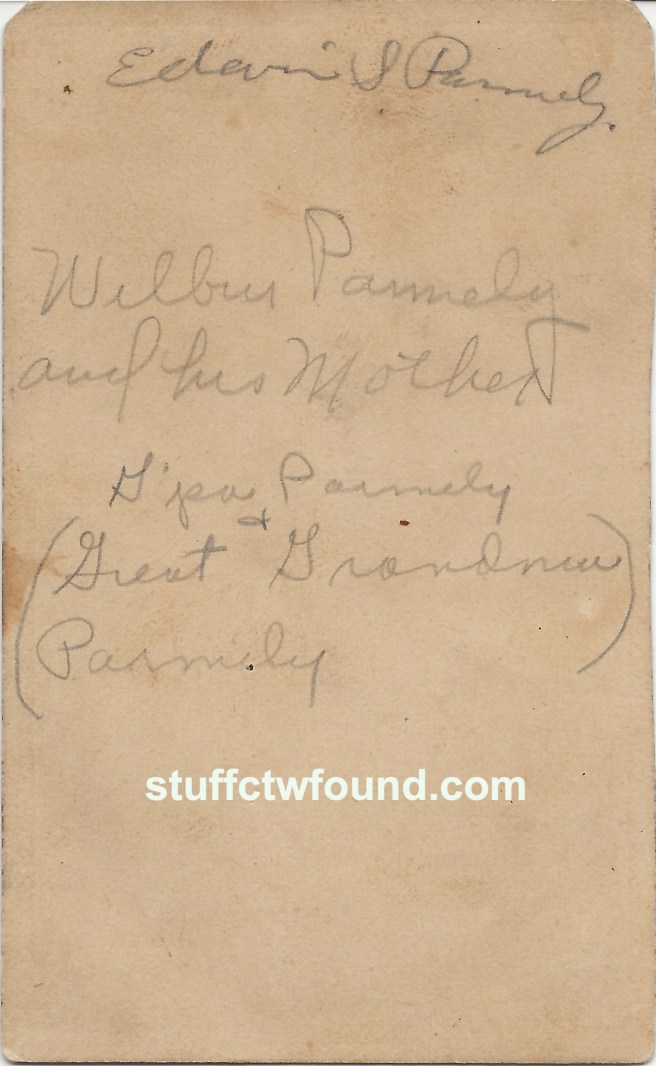
Wilbur Parmely and his Mother (G’pa Parmely & Great Grandma Parmely)
The subjects of the above photograph are as James Wilbur Parmely (1863-1922) and his mother Elizabeth Toay Ferrill (1844-1908). As you can see below, the reverse of the photograph also shows the name of Wilbur’s son Edwin Samuel Parmely (1890-1957). I resolved this possible confusion by dating Elizabeth’s dress to the 1860s. This photograph was purchased from Artifacts, Antiques, and Art on Main Street in Spearfish, SD by a StuffCTWFound.com field operative.
Elizabeth was born in Montreal, one of five children of James Ferrill (1799-1864) and Mary Toay (1810-1888) of Cornwall, England. The couple married in 1834, moved to Canada in the 1840s, and had settled in Wisconsin by 1849. There she married Melvin Augustus Parmely (1843-1910) in 1862 and Wilbur was the first of their 12 children.
Melvin was born in Missouri, the first of more than 20 children fathered by Ellsworth M. Parmely (1819-1913) and his four wives. Rhoda Emmaline Knowlton (1819-1855) was his mother. Melvin’s roots were also in southern England: John Parmely (1615-1689), Melvin’s fourth great-grandfather, emigrated from East Sussex, England to the Connecticut Colony in 1639. Soon after Melvin was born the family moved to Wisconsin, then to Iowa, then to South Dakota in about 1882. He received four land patents in Hand County, SD between 1888 and 1901.
Wilbur was born in Wisconsin. He was a farmer all his life. He married Isabella Hastings Barrett (1870-1910) in Hand County in 1890. Isabella had emigrated from Scotland with her parents, Thomas Barrett (1851-1905) and Mary Stevenson (1850-1918), in 1871 and spent time in Pennsylvania and Iowa before settling in South Dakota. Wilbur and Isabella had five children.
The Parmely family is very well documented on genealogy websites and there is a comprehensive family website where I reckon this photograph may one day appear. There is also a cache of letters from the early 1800s in the Sylvanus and Lois Gould Parmely Collection at the William L. Clements Library at the University of Michigan. Sylvanus (1784-1874) and Lois (1789-1873) were Melvin’s paternal grandparents and early settlers in Ashland and Lorain Counties in Ohio.
The inscription on the back of the above photograph (see below) says “Me, Sallie Vann Yokley.” We’ve seen over the years that people sometimes do not have precise memories of faces in photographs and the identities of their owners, but we usually take it for granted that the inscriber recognizes herself. In this batch there is some doubt about who everybody else might be.
Sallie Branch Vann (1890-1980) was born in Enfield, NC to Macon Edward Vann (1862-1932), a ship pipefitter, mail carrier, and bookkeeper, and Sallie Branch (1866-1890) who were married in Halifax County, NC in 1887. Her mother died 31 days after she was born. Her only sibling was her older brother, John Richard Vann (1888-1971).
Sallie married William Ross Yokley (1884-1970), a Baptist minister known as Ross, in 1914 at in Pineville, KY. The ceremony was performed by William Cartwright Sale (1876-1958), who may have been an Army buddy of Ross’s, and Sale’s wife, Grace Porter (1875-1953), played “Hearts and Flowers.” Sallie and Ross probably met while both were students at the “Missionary Training School” in Louisville. Ross was born Hughsville, MO to Amos N. Yokley (1859-1949) of NC and Mollie Ann Smith (1857-1920) of KY. After studying at William Jewell College in Liberty, MO, Ross was ordained at his home church, Bethel Baptist Church near La Monte, MO in 1907. Ross served at churches from Ohio to Florida, and as a chaplain in the U. S. Army and the Civilian Conservation Corps. They had five children: Mary Virginia Yokley (1915-2004); Sarah Virginia Yokley (1916-2009); Josephine Hunter Yokley (1918-1997); William Ross Yokley, Jr (1921-1952); and Carolyn Dehaven Yokley (1927-1999). Sallie, Ross, Sr., and Ross Jr. are buried in the Zachary Taylor National Cemetery in Louisville.
Sallie wrote on the back of the following photograph that its subject is Lutie Mary Love (1892-1977). She did not name the dogs.
Lutie Morrison Love
Lutie Mary Morrison (1892-1977) was born in Lynchburg, VA to James Nelson Morrison (1848-1926) and Lutie Ann Bunch (1848-1940). She married Jacob Taylor Love (1889-1945) and they had four children.
The inscription on the back of the following photograph identifies the ladies as Edith Boswell and Sallie Vann Yokley. I could not find Edith Boswell and suspect the lady on the right is actually Lutie Morrison Love.
Identified as Edith Boswell and Sallie Van Yokley
The last photograph is inscribed, “Harlan, KY, 1914.”
“Harlan, KY 1914”
Following are the backs of the photographs in order of their appearance.